

Walk down a typical toy aisle and you’re surrounded by flashing plastic gadgets that sing, bark, and light up at the press of a single button—leaving toddlers passively watching the toy perform instead of using their own hands and imagination.
Montessori-inspired toys take the opposite approach: crafted from tactile wood and simple materials, they isolate one skill at a time—such as shape sorting, pincer grasp, color matching, or real-life latches—and provide built-in ‘control of error’ so toddlers can see for themselves when they’ve solved the puzzle.
Better yet, you don’t need a $120 subscription play-kit box to build a rich Montessori shelf at home. Finding the best Montessori toys for toddlers under $30 on Amazon is easy when you focus on timeless, open-ended classics.
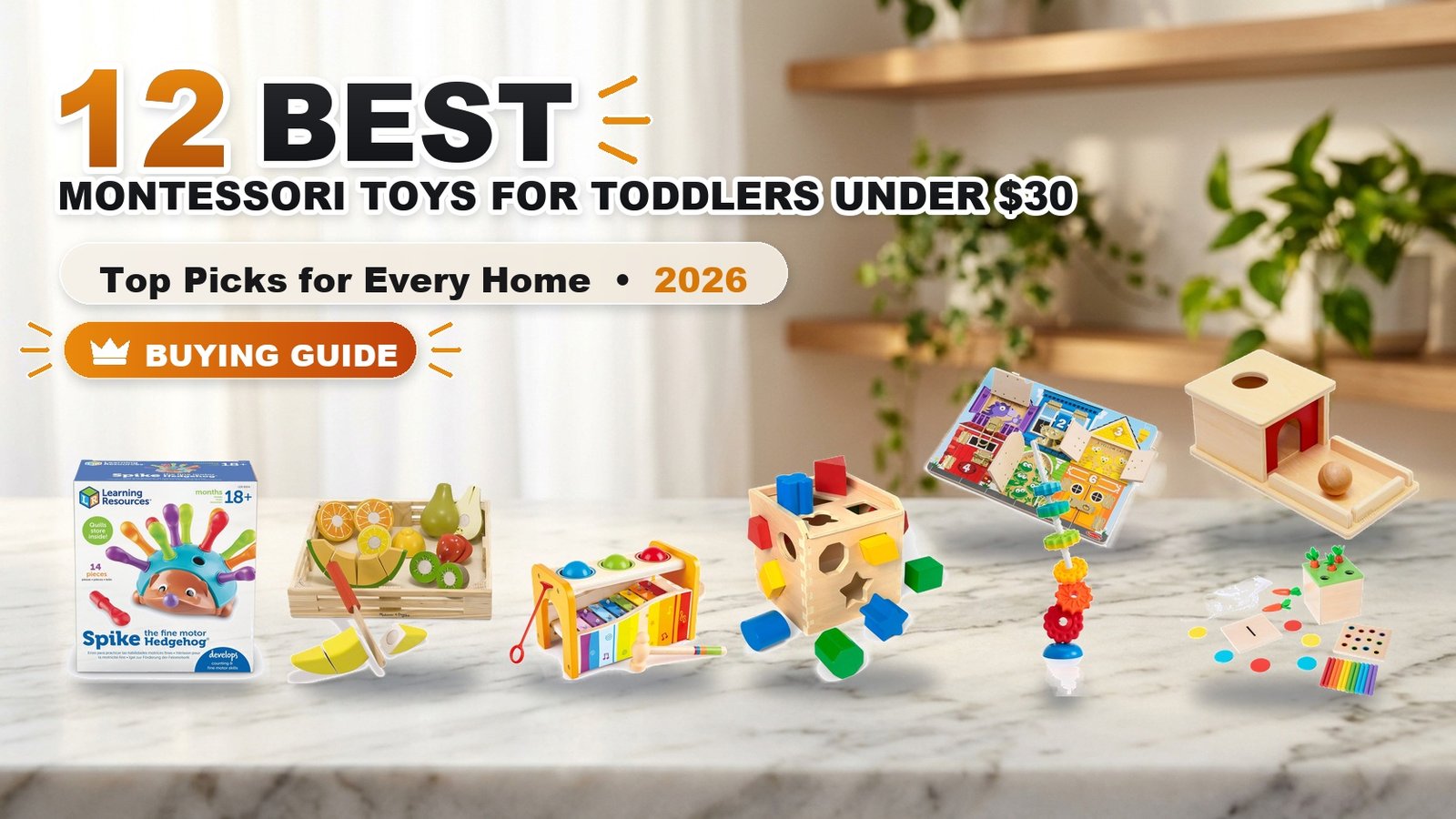
To help you curate a clutter-free play shelf for 1-, 2-, and 3-year-olds, we’ve selected 12 standout Montessori-aligned toddler toys under $30 from Melissa & Doug, Hape, Learning Resources, Fat Brain Toys, and Green Toys.
Quick Comparison: Best Montessori Toys for Toddlers Under $30 of 2026
| Product | Best For | Key Feature |
|---|---|---|
| Melissa & Doug Latches Board | Best Overall Practical Life Toy (2–4 yrs) | Solid wood board with 6 real metal brass/silver latches, hooks, chains, and numbered doors |
| Montessori Object Permanence Box | Best for Young Toddlers (9–18 mos) | Classic Montessori box where a wooden ball drops in the top hole and rolls out onto the front tray |
| Spike Fine Motor Hedgehog | Best Pincer-Grasp Peg Toy (18m+) | 12 chunky textured plastic ‘quills’ that store inside the hedgehog’s shell + numbered color holes |
| Melissa & Doug Cutting Fruit | Best Practical Kitchen Prep Toy | 7 sliceable wooden fruits held by self-stick Velcro tabs + wooden knife & storage crate |
| Hape Pound & Tap Xylophone | Best Musical & Cause-Effect Toy | Wooden hammering ball bench where falling balls cascade down a removable 8-note xylophone |
| Melissa & Doug Shape Cube | Best Classic Shape Sorter | Solid wood cube with 12 chunky geometric wooden blocks and a slide-off top lid |
| Fat Brain SpinAgain Stacker | Best Cause-Effect Ring Stacker | Corkscrew center pole with 6 dual-color gear discs that spin down + reversible wobble/flat base |
| Wooden Carrot & Coin Box | Best Multi-Lid Posting Box | Wooden box with interchangeable magnetic/slide lids for carrot planting, coin dropping & sticks |
| Hape Twist & Turnables | Best Wrist-Rotation Screw Blocks | 8 colorful wooden nuts and bolts in 4 geometric shapes that screw together by hand |
| Green Toys Stacking Cups | Best Under-$12 Nesting & Water Play | 6 graduated numbered cups made from 100% recycled milk jugs—nest, stack, or pour water |
| Rainbow Counting Bears & Cups | Best Color Sorting & Tongs Set (2.5–4 yrs) | Color-coded sorting cups, counting bears, and fine-motor scoop tongs in a storage tote |
| Montessori Dressing Busy Board | Best Travel & Self-Dressing Toy | Portable board with real zippers, snaps, coat buttons, belt buckles, and shoelaces |
These are category-based editorial recommendations, not results from a single comparative laboratory test. Specifications are based on manufacturer information; we have not independently tested every product.
1. Melissa & Doug Latches Wooden Activity Board – Best Overall Montessori Practical-Life Toy Under $30
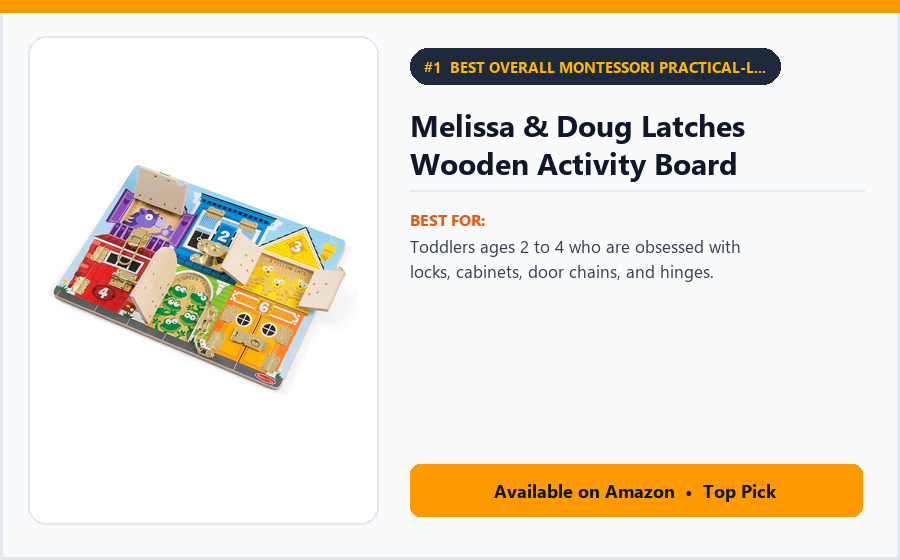
Best for: Toddlers ages 2 to 4 who are obsessed with locks, cabinets, door chains, and hinges.
Every parent of a two-year-old knows that toddlers would rather play with a real cabinet latch or front-door chain than a hundred plastic toys. Maria Montessori called this ‘Practical Life’ skill building.
The Melissa & Doug Latches Wooden Activity Board channels that natural curiosity into a safe, solid-wood board featuring six distinct real-metal locks and latches.
Key Features
Toddlers use two-handed coordination to undo a hook-and-eye latch, a sliding bar bolt, a toggle clasp, a cabinet hook, a chain lock, and a master padlock latch.
Behind each hinged wooden door sits a colorful illustration of animals corresponding to the numbers 1 through 6 printed on the outside.
Because all six metal latches and doors are permanently screwed onto the smooth wooden board, there are zero loose pieces to lose in the car or living room.
Why It’s Worth Considering
Occupational therapists use this exact board across the country to build wrist rotation, pincer strength, and bilateral hand coordination.
It is also a quiet-time lifesaver on airplanes, restaurant tables, and long road trips.
Keep an eye on 12-to-18-month-olds so they don’t pinch a fingertip when pressing the hinged wooden doors shut.
✓ Pros
- Six authentic metal latches build real-world wrist and finger dexterity.
- Zero loose pieces—everything stays attached to the solid wood board.
- Reinforces counting (1–6), colors, and animal recognition behind each door.
- 100% battery-free and screen-free quiet concentration.
- Durable solid wood construction well under $30.
✗ Cons
- Spring-loaded toggle clasp (#1) is stiff for younger 18-month hands at first.
- Hinged wooden doors require supervision for babies who slam flaps.
- Flat painted back can slide on slick wood tables unless set on a mat.
- Best starting around 20–24 months and up.
Our Verdict
The Melissa & Doug Latches Board is our #1 overall Montessori toy under $30, turning a toddler’s obsession with locks and hinges into focused, quiet skill-building.
Start by leaving the doors unlatched for younger toddlers so they can practice closing and hooking them first.
2. Elite Montessori Wooden Object Permanence Box with Tray & Ball – Best Authentic Montessori Object Permanence Box (9–18 Months)
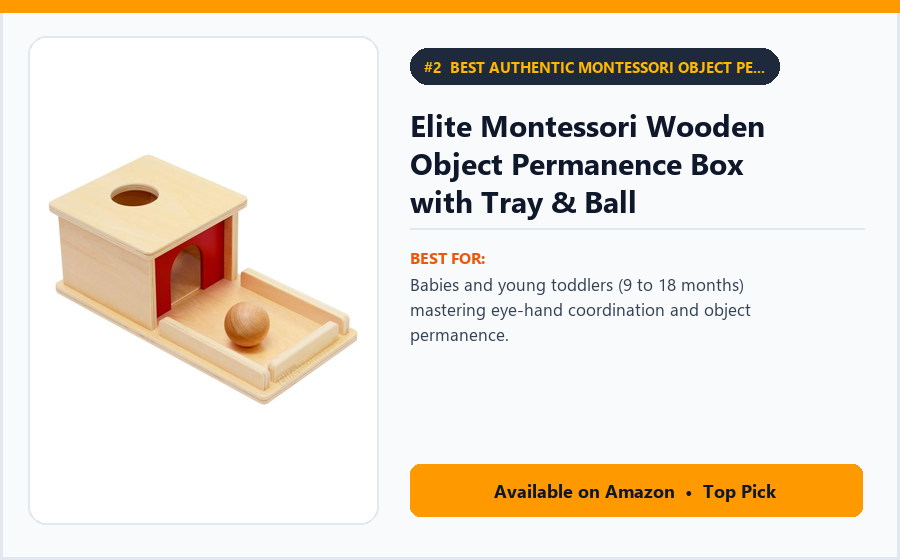
Best for: Babies and young toddlers (9 to 18 months) mastering eye-hand coordination and object permanence.
The Object Permanence Box is one of the most iconic authentic materials in a Montessori Infant-Toddler classroom. A child drops a smooth wooden ball through the circular hole on top—it disappears for a split second inside the box, then rolls out the front opening onto a wooden tray.
For a 10-to-15-month-old, watching that ball reappear every single time is pure magic—and they will repeat the drop-and-retrieve loop thirty times in a row.
Key Features
Crafted from sanded basswood/birch plywood with water-based non-toxic paint, the box isolates a single movement: palmar release directly over a target hole.
Because the front tray catches the rolling ball automatically, the ball doesn’t roll across the room and interrupt the child’s concentration.
The included wooden ball is sized at 1.75 inches in diameter (larger than a standard choke-tube test cylinder for infant safety).
Why It’s Worth Considering
Unlike busy multi-shape sorters that frustrate a 12-month-old, starting with a single round ball builds immediate confidence and focus.
Wipe the wood clean with a slightly damp cloth only—never soak wooden Montessori boxes in water.
✓ Pros
- Authentic Montessori classroom material for 9–18 month olds.
- Front catch tray keeps the ball within reach for independent repetition.
- Large 1.75-inch wooden ball is easy for small hands to grasp and release.
- Isolates one clear concept without overwhelming visual clutter.
- Affordable price under $20.
✗ Cons
- Single-skill toy that older 2.5-year-olds will outgrow once mastered.
- Wooden ball makes a loud clack if thrown onto hardwood floors.
- Do not submerge plywood in water.
- Includes one ball (keep track of it under sofas).
Our Verdict
The Elite Montessori Object Permanence Box is the best sub-$20 gift for a 1st birthday—delivering deep, self-directed focus for 9-to-18-month-olds.
Place it on a low shelf with the ball sitting right in the tray to invite independent play.
3. Learning Resources Spike the Fine Motor Hedgehog – Best Pincer-Grasp & Color-Sorting Toy Under $18
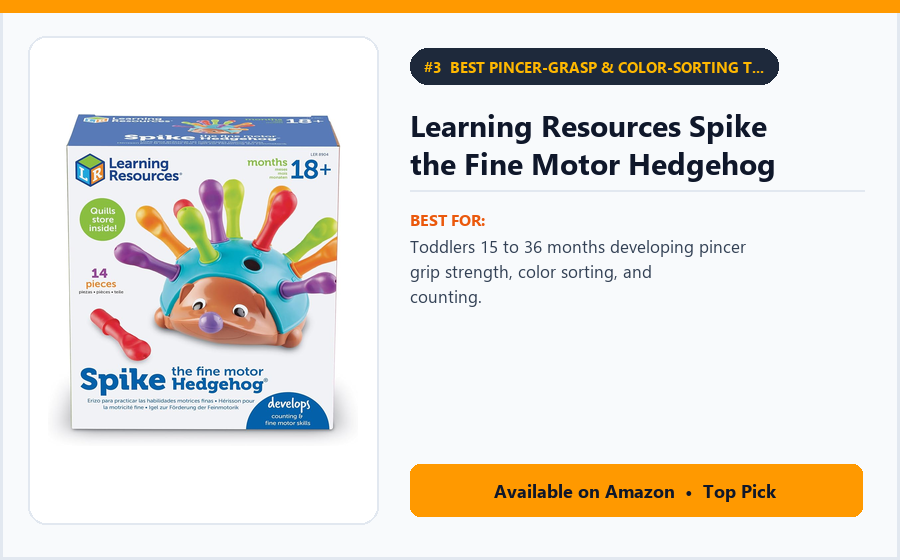
Best for: Toddlers 15 to 36 months developing pincer grip strength, color sorting, and counting.
Before a child can hold a crayon or button a shirt, they need to build strength in the thumb-and-index-finger ‘pincer grasp.’ Learning Resources’ Spike the Fine Motor Hedgehog makes that practice irresistible.
Toddlers pull twelve colorful, easy-grip peg ‘quills’ out of Spike’s back and push them back into the holes.
Key Features
Each quill has subtle indented grip dimples sized specifically for toddler fingers to grasp and push.
As your toddler grows from 15 months to 3 years, the game evolves: first they just pull quills out, then they push quills into any hole, then they match warm/cool colors, and finally they count the numbers 1–12 printed beside each hole.
Best of all for parents, Spike’s shell pops open so all 12 quills lock inside his belly for mess-free cleanup.
Why It’s Worth Considering
Because it is made of wipe-clean, BPA-free plastic, it is indestructible and easy to sanitize after playdates or sick days.
At regularly around $12 to $15 on Amazon, it is a top speech- and occupational-therapy staple.
✓ Pros
- Builds essential thumb-and-finger pincer grip strength.
- All 12 quills store neatly inside the hedgehog’s shell when done.
- Grows with your child from simple peg-pushing to color sorting and counting 1–12.
- Wipe-clean, durable construction survives drops.
- Bargain price well under $20.
✗ Cons
- Made of plastic rather than natural wood.
- Quills can roll under furniture if not put back inside the shell.
- Top shell lid fits snugly (younger 18-month-olds need a parent to pop the lid open).
- 12 holes, so losing one quill leaves a visible empty spot.
Our Verdict
Learning Resources Spike the Fine Motor Hedgehog is a must-own sub-$18 fine-motor builder for 1- and 2-year-olds, complete with built-in piece storage.
Start by putting only 4 quills out at a time for a 15-month-old so they aren’t overwhelmed.
4. Melissa & Doug Cutting Fruit Set (Wooden Play Food with Knife) – Best Montessori Wooden Cutting Fruit Set Under $25
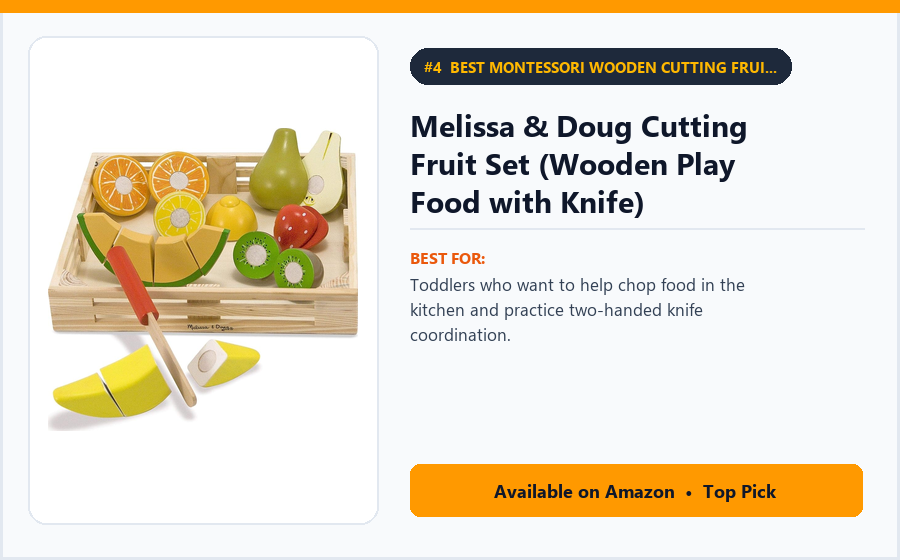
Best for: Toddlers who want to help chop food in the kitchen and practice two-handed knife coordination.
In a Montessori home, toddlers love imitating real kitchen work. The Melissa & Doug Wooden Cutting Fruit Set lets 2- and 3-year-olds practice holding a piece of fruit steady with their helper hand while slicing downward through the Velcro seam with a safe wooden knife.
As the wooden blade slices through each Velcro tab, it makes a deeply satisfying ‘crunch’ sound.
Key Features
The 17-piece set includes a wooden storage crate, a wooden play knife, and seven painted wooden fruits (strawberry, orange, plum, pear, lemon, kiwi, and melon) that slice into 15 sections.
Because different fruits slice into halves (2 pieces) or thirds (3 pieces), it naturally introduces early fraction concepts (‘two halves make one whole orange’) during play.
Sturdy Velcro pads hold the wooden pieces together across thousands of cuts.
Why It’s Worth Considering
Once your toddler masters steady two-handed technique on this wooden fruit set, they are ready to graduate to a real wavy nylon toddler lettuce/banana knife at the kitchen counter.
Keep pet hair and carpet lint off the Velcro pads so they stay grippy.
✓ Pros
- Teaches safe two-handed knife holding (one hand steadies, one hand slices).
- Satisfying ‘crunch’ sound from the Velcro tabs gives instant feedback.
- Solid wood pieces with painted interior fruit cross-sections.
- Introduces early fraction concepts (halves and thirds) naturally.
- Includes a wooden storage crate for shelf organization.
✗ Cons
- Does not include a flat wooden cutting board in the fruit-only crate (use a placemat).
- Velcro tabs can pick up rug lint if left on carpet.
- Wooden knife should be supervised so toddlers don’t tap glass tables.
- Paint can chip slightly if banged against tile floors.
Our Verdict
The Melissa & Doug Wooden Cutting Fruit Set is the best sub-$25 practical-life kitchen toy for building two-handed coordination before introducing toddler-safe real kitchen knives.
Set out just two fruits and the wooden knife on a small tray for focused toddler work.
5. Hape Pound & Tap Bench with Slide Out Xylophone – Best Montessori Musical Hammering & Xylophone Bench Under $30
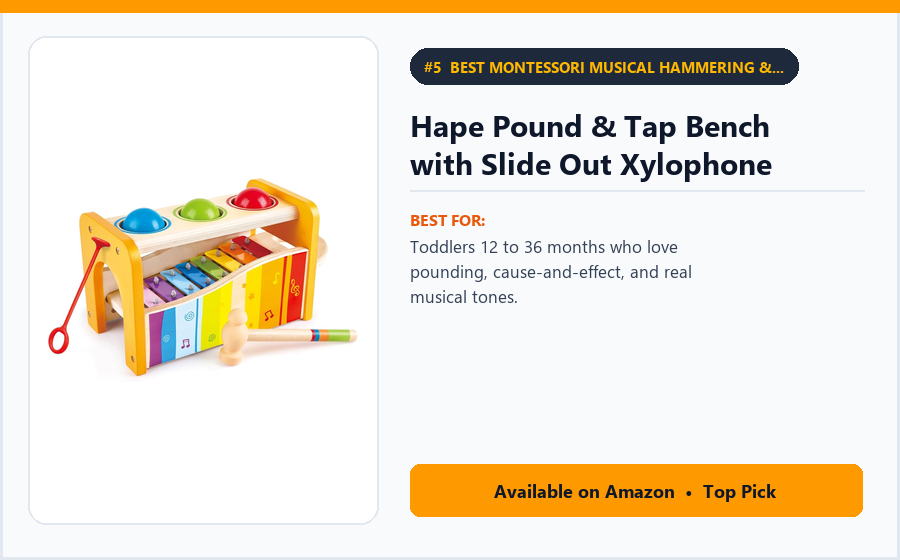
Best for: Toddlers 12 to 36 months who love pounding, cause-and-effect, and real musical tones.
Toddlers have a natural urge to bang things together to test how force and sound work. The Hape Pound & Tap Bench combines a classic wooden ball-hammering bench with a slide-out musical xylophone underneath.
When your toddler taps one of the three wooden balls through the top ring with the wooden mallet, the ball drops onto the xylophone keys and rolls down—playing a cheerful descending musical scale!
Key Features
Or, your toddler can pull the wooden xylophone out by its handle and play the eight color-coded metal keys directly on the floor as a standalone instrument.
Ring inserts around the three top holes provide gentle friction so balls stay put until tapped with the hammer (or pushed through with a palm).
Finished with non-toxic, child-safe water-based paints on solid wood.
Why It’s Worth Considering
Getting two classic wooden toys—a pounding bench AND a tuned xylophone—in one compact footprint under $30 makes this one of Hape’s most awarded toddler designs.
For younger 12-month-olds who haven’t mastered aiming a mallet yet, let them push the balls through with their hands first.
✓ Pros
- Two toys in one: a wooden ball-pounding bench and a removable xylophone.
- Falling balls automatically play a musical scale as they roll down the keys.
- Can be pushed by hand (for 12m+) or tapped with the mallet (for 18m+).
- Heirloom-quality solid wood and non-toxic water-based finishes.
- Pleasant acoustic chime rather than electronic speaker noise.
✗ Cons
- Three wooden balls can roll under the sofa if the xylophone is removed.
- Supervise the wooden mallet around glass coffee tables or pets.
- Xylophone keys are tuned for pleasant play rather than concert pitch.
- Mallet does not have a dedicated clip-in slot on the bench.
Our Verdict
The Hape Pound & Tap Bench with Slide Out Xylophone is our favorite musical and hand-eye coordination toy under $30 for 1- and 2-year-olds.
Keep a small basket beside the bench on your shelf to hold the three balls and mallet neatly.
6. Melissa & Doug Shape Sorting Cube Classic Wooden Toy – Best Classic Wooden Shape Sorting Cube Under $20
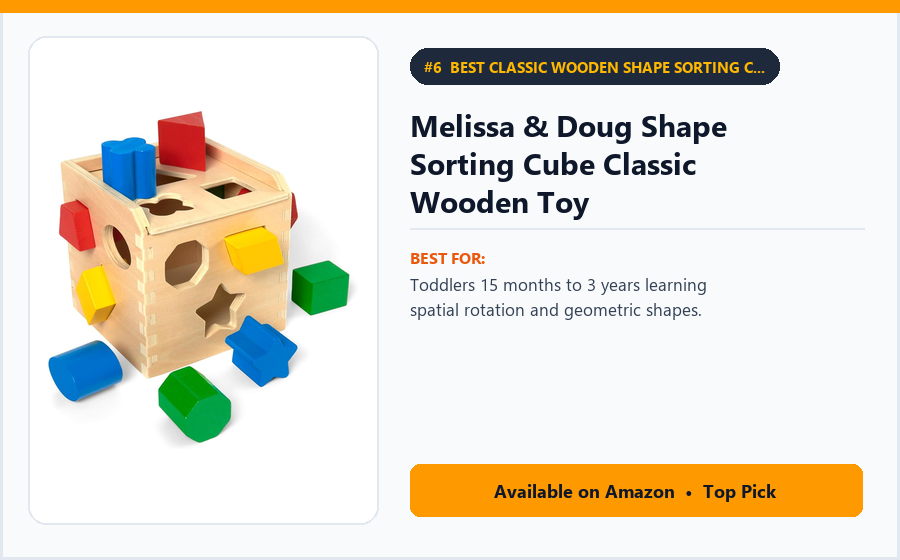
Best for: Toddlers 15 months to 3 years learning spatial rotation and geometric shapes.
Why is a wooden shape sorter a Montessori classic? Because it features 100% built-in control of error: a square peg simply will not fit through a triangle hole—the toy itself gently teaches the child to rotate their wrist and try again without an adult saying ‘no, that’s wrong.’
The Melissa & Doug Shape Sorting Cube features 12 chunky, brightly colored solid-wood shapes across four sides of a natural hardwood box.
Key Features
Shapes range from simple beginner symmetries (circle, square, triangle, octagon) to advanced directional shapes (star, parallelogram, trapezoid, oval, clover) that require rotating the block in 3D space.
When all the blocks are inside, the top wooden lid slides smoothly out of its groove so your toddler can dump them out and start over.
Every block is large, solid hardwood with zero batteries or electronics.
Why It’s Worth Considering
MONTESSORI PRO TIP: A 15-month-old will get frustrated if handed all 12 complex shapes at once! Put a piece of painter’s tape over the hard holes at first and offer only the Circle, Square, and Triangle—then open new shapes as their spatial skills grow.
All 12 blocks store inside the cube on the shelf.
✓ Pros
- True self-correcting design teaches spatial rotation without adult correction.
- Progresses from simple circles/squares to challenging stars and trapezoids.
- Heavy-duty solid hardwood construction lasts through multiple siblings.
- Slide-out wooden lid stores all 12 blocks inside the cube.
- Costs under $20 on Amazon.
✗ Cons
- 12 shapes all at once can overwhelm a 14-month-old (introduce 3 shapes first!).
- Dropping hardwood blocks into the wooden box makes a loud clatter.
- Slide-off wooden lid can pinch fingers if slid shut carelessly.
- Corners of the hardwood cube are firm—keep on floor or low table.
Our Verdict
The Melissa & Doug Shape Sorting Cube is the gold-standard wooden shape sorter under $20—building spatial reasoning from 15 months all the way to age 3.
Start by giving your toddler only the circle and square blocks so they experience instant success.
7. Fat Brain Toys SpinAgain Stacking Toy – Best Dynamic Stacking & Spinning Ring Toy Under $30
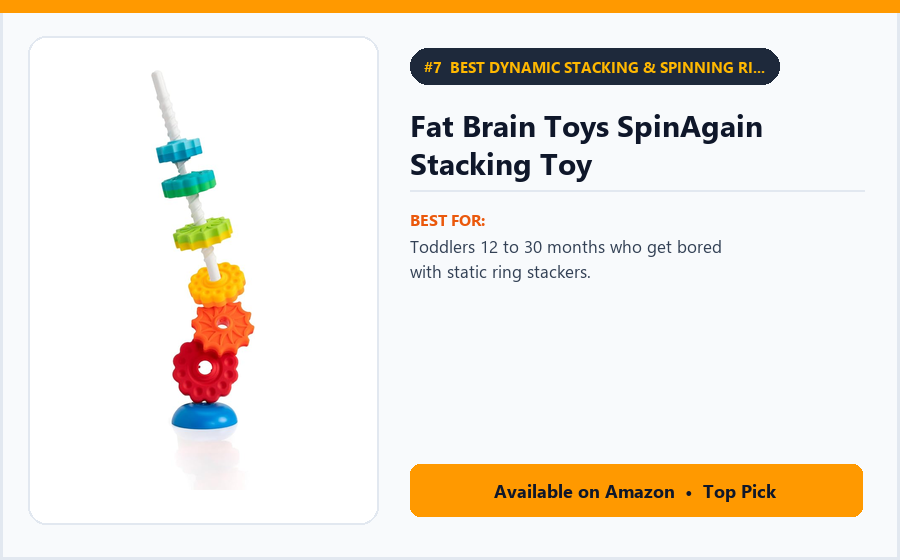
Best for: Toddlers 12 to 30 months who get bored with static ring stackers.
Once a toddler puts a ring onto a standard wooden dowel, nothing happens—it just sits there. Fat Brain Toys reinvented the classic ring stacker with the SpinAgain by replacing the smooth dowel with a threaded corkscrew pole.
The moment your toddler places a star or flower disc onto the top of the pole and lets go, the disc whirls and spins all the way down to the bottom!
Key Features
Six graduated dual-colored ABS plastic discs (ranging from large magenta/lime at the bottom to small sky-blue at the top) teach size ordering and color recognition.
The base can be flipped either way: curved-side down for a gentle wobbling challenge, or flat-side down for stable beginner stacking.
Best of all, when your toddler pulls the entire center corkscrew pole straight up out of the base, all six discs spin off the bottom at once across the floor!
Why It’s Worth Considering
Even toddlers who normally walk away from stacking toys after 30 seconds will sit and stack the SpinAgain over and over to watch the hypnotic spinning drop.
Made from thick, BPA-free matte-textured plastic that washes easily in warm soapy water.
✓ Pros
- Mesmerizing corkscrew spin rewards every single ring placement.
- Discs stack in any order (for 12m+) or by graduated size (for 24m+).
- Pulling the center pole up releases all 6 discs in a fun finale.
- Reversible base switches between wobble mode and flat stable mode.
- Thick, matte BPA-free plastic is nearly indestructible.
✗ Cons
- Made of high-grade ABS plastic rather than wood.
- Center pole detaches from the base (supervise so kids don’t wave the pole).
- Tall 16-inch height requires vertical shelf clearance.
- Spinning discs make a zippy whirring sound.
Our Verdict
The Fat Brain Toys SpinAgain is the most engaging ring stacker under $30, turning hand-eye coordination practice into an addictive spinning game.
Set the base flat-side down for 12-month-olds, then flip it to wobble mode once they turn two.
8. Montessori Wooden Carrot Harvest & Coin Drop Multi-Lid Box (4-in-1) – Best Multi-Activity Montessori Posting & Carrot Harvest Box Under $28
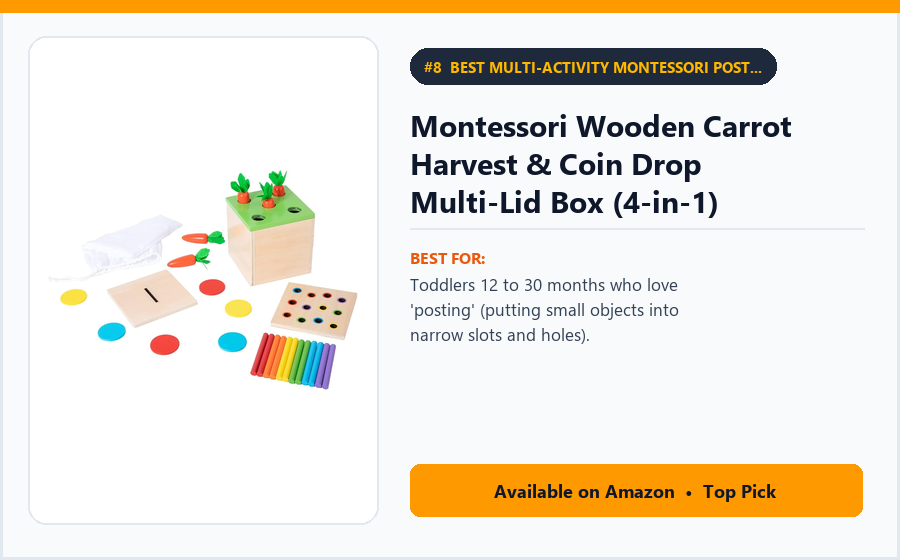
Best for: Toddlers 12 to 30 months who love ‘posting’ (putting small objects into narrow slots and holes).
Between 12 and 24 months, toddlers enter what Montessori educators call the ‘Posting Sensitive Period’—an intense developmental drive to fit coins into narrow slots, sticks into small holes, and carrots into garden sockets.
Instead of buying four separate wooden boxes, a 4-in-1 Montessori Wooden Carrot Harvest & Coin Box gives you one wooden base with interchangeable top lids.
Key Features
Swap on the Carrot Harvest Lid to let toddlers plant and pull five graduated-size wooden carrots with felt leaves into matching-width holes.
Swap on the Coin Drop Lid so toddlers can rotate flat wooden coins vertically to slip through a narrow piggy-bank slot.
Additional lids include color-matched drop sticks (like pick-up sticks into color holes) that require a refined tripod finger grip.
Why It’s Worth Considering
Only put one lid and its matching pieces out on your toddler’s shelf at a time (keep the other three lids in your closet and rotate them every Monday so the toy feels brand new!).
Note: always supervise toddlers under 3 around the narrower color-match drop sticks or coins.
✓ Pros
- Includes 4 distinct Montessori posting activities in one compact wooden box.
- Graduated wooden carrots teach size discrimination (thick vs. thin holes).
- Coin-slot lid builds wrist rotation and slot alignment.
- All pieces and spare lids store inside the wooden box.
- Great value under $28 compared with buying 4 separate boxes.
✗ Cons
- Small color sticks and coins require adult supervision for children who still mouth objects.
- Giving all 4 lids at once causes a jumbled mess (only offer 1 lid at a time!).
- Felt carrot leaves can fray if pulled by dogs or chewed.
- Sanded wood should be wiped dry, never soaked.
Our Verdict
A 4-in-1 Montessori Wooden Carrot Harvest & Coin Drop Box is a powerhouse fine-motor value under $28—giving you four rotating shelf activities in one box.
Start with the chunky Carrot Harvest lid at 12–15 months, then rotate to the Coin Slot lid around 18 months.
9. Hape Twist & Turnables Wooden Building Blocks – Best Montessori Wooden Nut & Bolt Wrist-Rotation Toy Under $20
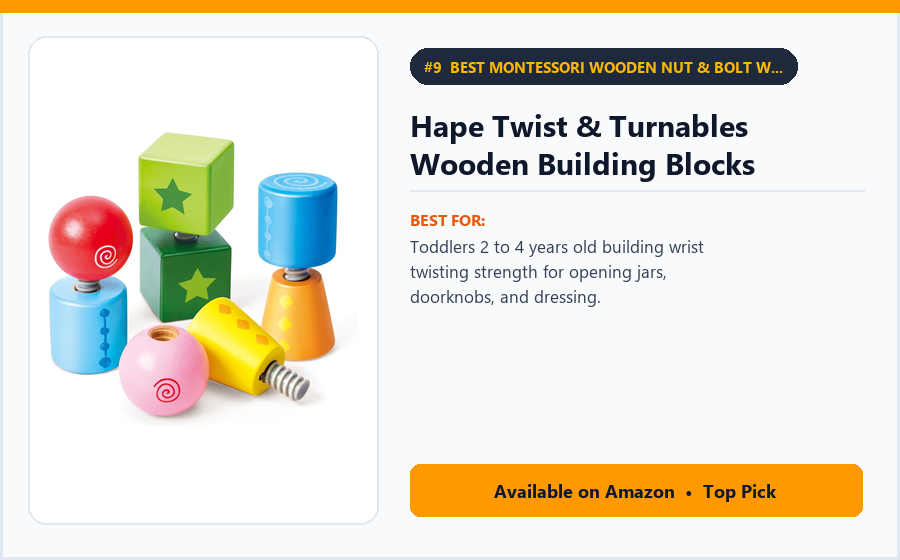
Best for: Toddlers 2 to 4 years old building wrist twisting strength for opening jars, doorknobs, and dressing.
Twisting a doorknob, unscrewing a water bottle cap, and using a screwdriver all rely on supination and pronation—the ability to rotate the forearm and wrist clockwise and counterclockwise.
The Hape Twist & Turnables set turns that exact mechanical motion into open-ended wooden block building.
Key Features
The 8-piece hardwood set includes four threaded wooden bolt posts and four matching threaded wooden nuts in different colors and shapes (circle, square, triangle, octagon).
Toddlers can match them by color and shape, or mix and match to screw together tall totem towers and caterpillars.
Large, chunky wooden threads are easy for two-year-old hands to align without cross-threading.
Why It’s Worth Considering
Because it packs into a tiny Ziploc pouch or coat pocket with zero noise, it is one of the best restaurant-waiting and airplane tray-table toys you can own for under $18.
Made from FSC-certified solid maple wood with child-safe water-based stains.
✓ Pros
- Directly strengthens wrist twisting muscles needed for doorknobs and bottle caps.
- Large wooden threads are easy for toddler fingers to start and spin.
- Teaches color, shape, and pattern matching.
- Solid maple hardwood with non-toxic water-based paint.
- Compact, quiet, and travel-friendly under $20.
✗ Cons
- 8 pieces total (4 bolts + 4 nuts)—buying two sets doubles the building possibilities.
- Too challenging for 12-month-olds (best for 22–24 months and up).
- Does not include a storage bag in the box.
- Round pieces will roll if dropped on airplane floors.
Our Verdict
Hape Twist & Turnables are the best sub-$20 Montessori manipulative for building wrist-rotation strength and quiet travel focus in 2- and 3-year-olds.
Keep them in a small drawstring cloth bag in your diaper bag or restaurant tote.
10. Green Toys Stacking Cups (Set of 6 Pouring & Bath Cups) – Best Budget Montessori Nesting, Pouring & Bath Cups Under $12
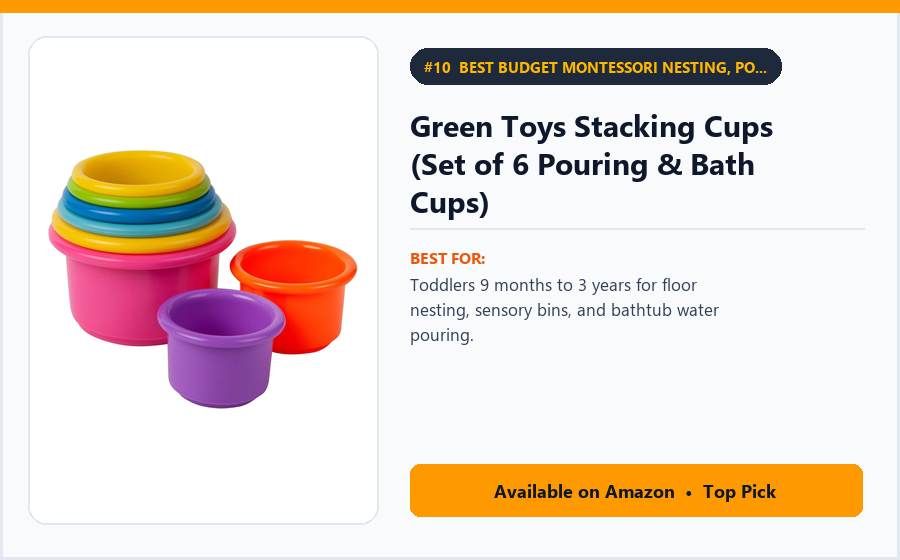
Best for: Toddlers 9 months to 3 years for floor nesting, sensory bins, and bathtub water pouring.
Sometimes the simplest $10 toy gets more daily play than anything else in the house. Green Toys’ Set of 6 Stacking Cups teaches size gradation, volume math, nesting, and water pouring in one indestructible package.
Made in the USA from 100% recycled plastic milk jugs with zero BPA, phthalates, or external paint coatings, they are completely safe for teething, bath time, and even scooping snacks.
Key Features
Flip them upside down to stack a tower from largest (#6) to smallest (#1), or turn them right-side up to nest all six cups inside one another.
Cleverly, the volume of the cups is mathematically proportional: filling Cup #1 and Cup #2 with water and pouring both into Cup #3 fills Cup #3 to the exact rim (1 + 2 = 3)!
Because there are no holes in the bottom of the cups, they are ideal for Montessori dry-bean or water-pouring transfer trays.
Why It’s Worth Considering
When they get sticky from sandbox mud, playdough, or bath soap, you toss them straight onto the top rack of your dishwasher.
At around $8 to $11 on Amazon, every toddler home should own a set.
✓ Pros
- Costs around $10 and works on the floor, in the bath, at the beach, or on pouring trays.
- Mathematically sized so Cup 1 + Cup 2 equals the exact volume of Cup 3.
- Solid bottoms (no holes) allow real Montessori water and dry-bean pouring work.
- Made in the USA from 100% recycled food-safe milk jugs.
- 100% dishwasher-safe and nests into a tiny 4-inch stack.
✗ Cons
- Smooth rims require a flat surface when stacking upside down into a tall tower.
- Recycled plastic rather than wood (though ideal for water and bath play).
- Numbers on the bottom are molded in the same color rather than high-contrast ink.
- Six cups (some taller sets include 8–10 cups).
Our Verdict
The Green Toys Stacking Cups are the best under-$12 Montessori staple on Amazon—transitioning effortlessly from dry floor nesting to bathtub and sensory-bin pouring.
Set two cups on a small tray with dry uncooked pasta or water so your 2-year-old can practice pouring from one cup to the other.
11. Skoolzy / Learning Resources Rainbow Counting Bears with Matching Cups & Tongs – Best Montessori Color Sorting, Counting & Tongs Transfer Kit Under $25
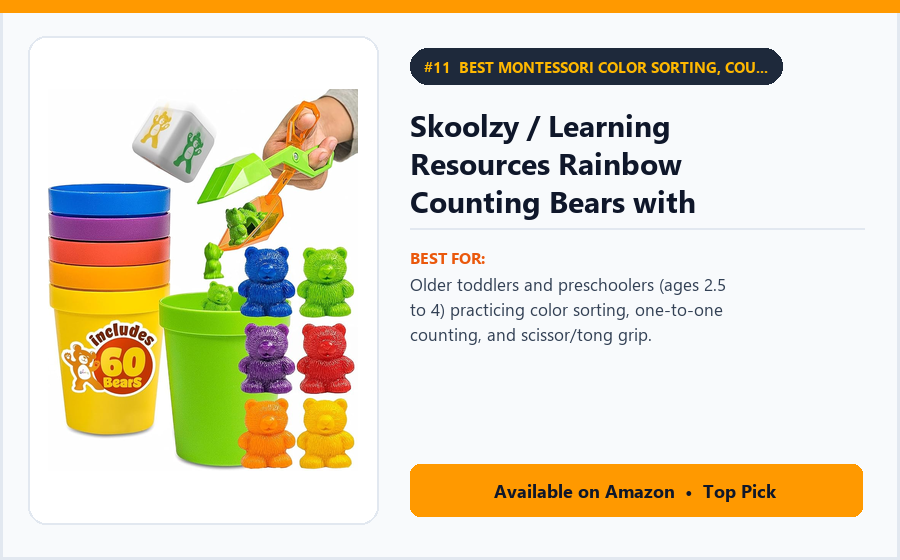
Best for: Older toddlers and preschoolers (ages 2.5 to 4) practicing color sorting, one-to-one counting, and scissor/tong grip.
In a Montessori classroom, ‘tonging and sorting’ trays are a daily favorite for 2.5- to 4-year-olds: using small tongs to pick up colored objects and sort them into matching bowls builds the exact hand-arch muscles needed for using scissors and pencils.
The Skoolzy Rainbow Counting Bears Kit bundles color-coded cups, weighted plastic bears, and toddler-sized scoop tongs in one zippered bag.
Key Features
Toddlers start by sorting bears by color into the six matching rainbow cups (Red, Orange, Yellow, Green, Blue, Purple).
Squeezing the included scissor-style scoop tongs to pick up each bear adds a rewarding fine-motor challenge.
For 3- and 4-year-olds, the set supports pattern-making (Red-Blue-Red-Blue), counting, and sensory-bin hide-and-seek in kinetic sand or dry rice.
Why It’s Worth Considering
IMPORTANT SAFETY NOTE: Because individual counting bears are small (~1 inch tall), this set is strictly for toddlers 2.5 to 3+ years old who no longer put small toys in their mouth (or for closely supervised table work).
Put out just 3 cups and 15 bears on a tray rather than dumping all 60 bears at once.
✓ Pros
- Builds color sorting, counting, patterning, and scissor-tong hand strength.
- Includes matching colored cups, tongs, and a zippered storage bag.
- Bears and cups are washable for use in water tables, playdough, or rice bins.
- Grows with children from age 2.5 through kindergarten math.
- Affordable complete kit under $25.
✗ Cons
- Small 1-inch bears are a choking hazard for children under 3 or mouthers—supervise closely!
- Dumping all 60+ bears at once creates floor clutter (only offer 10–15 at a time).
- Included plastic tongs can be stiff for very small hands.
- Plastic construction.
Our Verdict
The Skoolzy Rainbow Counting Bears with Cups & Tongs is the best sub-$25 color-sorting and pre-writing tong kit for older toddlers (2.5–4 years) who are past the mouthing stage.
Pair it with a muffin tin for even easier table sorting.
12. Montessori Wooden Busy Board / Felt Dressing Board (Zippers, Buckles & Laces) – Best Montessori Self-Dressing & Travel Busy Board Under $25

Best for: Toddlers 18 months to 4 years learning to zip jackets, snap buttons, and buckle straps—especially for car and plane travel.
One of Maria Montessori’s original classroom inventions was the ‘Dressing Frame’—a board that lets toddlers practice zipping zippers, snapping buttons, and clicking buckles while laying flat on their lap (which is much easier than trying to zip a jacket while wearing it!).
Modern Montessori Busy Boards (available in soft travel feltbooks or smooth wooden boards under $25) combine eight to ten self-dressing fasteners in one carry-handle package.
Key Features
Toddlers practice pinching and sliding a real zipper, clicking side-release backpack buckles, buttoning a large shirt button through a buttonhole, fastening Velcro straps, and threading shoelaces.
Soft felt binder versions weigh under a pound, make zero noise if dropped in a car seat, and include alphabet/clock/shape pages inside.
Wooden sensory-board versions offer tactile light switches, spinning gears, and spring latches.
Why It’s Worth Considering
Mastering backpack clips and jacket zippers on a busy board directly translates to independent morning dressing for preschool.
If buying a felt busy book for car seats or flights, choose one where all main buckles and zippers are stitched permanently onto the page.
✓ Pros
- Teaches real self-dressing skills (zippers, buttons, snaps, and buckles).
- Soft felt book versions are featherweight, silent, and safe for car seats and flights.
- Keeps busy hands occupied during doctor’s office waits and long drives.
- Builds two-handed coordination and finger pinch strength.
- Costs well under $25.
✗ Cons
- Check stitching on felt boards occasionally if your toddler pulls hard on Velcro pieces.
- Buttoning and shoelace tying are advanced skills for 3–4 year olds (18m olds start with Velcro and zippers).
- Felt versions with 20+ loose Velcro alphabet letters can get messy in the car (remove loose letters before travel).
- Spot-clean only.
Our Verdict
A Montessori Self-Dressing Busy Board is the best sub-$25 travel and life-skills toy for 18-to-48-month-olds—keeping hands busy in the car while teaching real zipper and buckle independence.
Leave the zippers and buckles half-open when handing it to your toddler so they see immediately how the mechanism moves.
How to Choose the Best Montessori Toys for Toddlers Under $30 in 2026
The word ‘Montessori’ isn’t trademarked, meaning thousands of flashing plastic toys slap ‘Montessori’ into their Amazon titles just for search clicks.
Here are the six real principles that make a toddler toy genuinely Montessori-aligned in 2026.
1. Look for ‘Isolation of Difficulty’ (One Skill at a Time)
A toy that has a piano, a shape sorter, a spinning steering wheel, and flashing French numbers all on one plastic cube scatters a toddler’s attention.
True Montessori toys focus on one clear challenge: dropping a ball in a hole (Object Permanence Box), matching shapes (Sorting Cube), or opening latches (Latches Board).
2. Choose Passive Toys That Require an Active Child
A good rule of thumb: the less a toy does on its own with batteries, the more your toddler’s brain and hands have to do.
All 12 picks in this guide are 100% battery-free, powered entirely by your child’s curiosity and movement.
3. Prioritize Built-In ‘Control of Error’ (Self-Correcting Design)
Instead of a toy buzzing ‘Wrong!’ or requiring a parent to correct the child, a Montessori toy shows the child physically when a task is complete: a square block only fits in the square hole, and a puzzle piece only sits flat in its matching cutout.
4. Favor Natural, Tactile Materials (Wood, Metal, Cotton)
Solid hardwood (like maple, beech, or birch), real brass latches, and smooth cotton feel warm, have real weight in the hand, and teach children to handle objects with care.
5. Practice Toy Rotation (Only 6 to 8 Toys on the Shelf!)
Even the best Montessori toys get ignored if 40 of them are dumped into a deep toy chest.
Display just 6 to 8 toys at a time on a low, open shelf with space between each item (and only 3–4 pieces out per puzzle for young toddlers). Put the rest in a closet bin and swap 2 toys out every week or two!
6. Match the Toy to Your Toddler’s Current ‘Sensitive Period’
9–16 Months: Object Permanence Box, Green Toys Stacking Cups, Hape Pound Bench.
15–24 Months: Spike the Hedgehog, SpinAgain Stacker, Carrot Harvest Box, Shape Sorting Cube (3 shapes out).
24–40 Months: Melissa & Doug Latches Board, Cutting Fruit Set, Hape Twist & Turnables, Busy Board, Counting Bears.
Posting & Sorting Boxes vs. Practical-Life Boards vs. Fine-Motor Pegs & Bolts: Which Is Better?
A balanced toddler shelf includes one item from each of these three Montessori developmental categories.
| Feature | Posting & Shape Sorting | Practical Life & Imitation | Fine-Motor Grip & Wrist Twist |
|---|---|---|---|
| Top examples | Object Permanence Box, Shape Cube, Carrot Harvest Box, Stacking Cups | Latches Board, Wooden Cutting Fruit, Self-Dressing Busy Board | Spike Hedgehog, Hape Twist & Turnables, SpinAgain, Counting Bears |
| Primary developmental goal | Spatial awareness, size/shape discrimination, hand-eye aim | Real-world independence (locks, slicing, zippers, pouring) | Pincer grasp, wrist rotation & pre-writing hand strength |
| Peak toddler age window | 10 months to 2.5 years | 18 months to 4 years | 15 months to 3.5 years |
| Travel suitability | Moderate (multiple blocks) | High (Latches Board & Busy Board have zero loose parts) | High (Spike stores quills inside; Bolts fit in a pouch) |
Which One Should You Buy First?
If you are shopping for a 1-year-old (10–18 months), start with the Elite Montessori Object Permanence Box, Green Toys Stacking Cups, and Fat Brain SpinAgain.
If you are shopping for an 18-to-24-month-old, grab Spike the Fine Motor Hedgehog, the Carrot Harvest & Coin Box, and Hape Pound & Tap Xylophone.
If you are shopping for a 2- to 3-year-old, buy the Melissa & Doug Latches Board, Wooden Cutting Fruit Set, and Hape Twist & Turnables.
Are Expensive $80–$120 Montessori Subscription Boxes Necessary?
Subscription play kits like Lovevery and Monti Kids are beautifully curated, but at $80 to $120 every two to three months, they cost nearly $500 to $700 a year.
Look inside those boxes and you’ll find the exact same core developmental materials—an object permanence box, stacking cups, a peg hedgehog/board, wooden latches, and a shape sorter—that you can buy individually on Amazon from Melissa & Doug, Hape, Learning Resources, and Green Toys for $10 to $25 each.
Buying three targeted toys under $30 that match what your toddler is actually interested in this month saves hundreds of dollars while avoiding unwanted extras.
Instead of focusing entirely on the initial purchase price, ask three questions:
- What physical motion is my toddler repeating right now (dropping items into holes, twisting caps, opening doors, or stacking)?
- Does this toy work 100% without batteries or flashing lights?
- Can I reduce the number of loose pieces on day one so my toddler isn’t overwhelmed?
If you can answer these questions clearly, you’re more likely to make a purchase you’ll appreciate over the long term.
Frequently Asked Questions About Montessori Toys for Toddlers Under $30
What is the best Montessori toy for toddlers under $30 in 2026?
The Melissa & Doug Latches Wooden Activity Board is our top overall pick for toddlers ages 2–4 because its six real metal locks build two-handed coordination with zero loose parts, while the Object Permanence Box and Spike the Hedgehog lead for 1-year-olds.
What makes a toy a ‘Montessori toy’?
Montessori-aligned toys are passive, battery-free materials made primarily from natural textures (like wood, metal, or cotton) that isolate one real-world skill or concept at a time and allow the child to self-correct their own work.
Why does my toddler just dump all the Montessori puzzle pieces on the floor and walk away?
When a toy has too many pieces out at once (like 12 shape blocks or 60 counting bears), a young toddler gets overwhelmed and resorts to dumping! Put 75% of the pieces in a closet Ziploc bag and leave only 3 or 4 pieces on the tray—watch how quickly they focus.
Are plastic toys like Spike the Hedgehog or Green Toys Cups allowed in Montessori?
Absolutely! Maria Montessori used natural materials because those were the highest-quality materials of her era—she cared most about purposeful, self-correcting hand work. A battery-free peg hedgehog or mathematically graduated pouring cup is 100% Montessori-aligned in function.
How do you introduce a new Montessori toy to a toddler?
Instead of explaining the toy with lots of words, sit beside your toddler and slowly, silently demonstrate the action once with your hands (e.g., slowly picking up the wooden ball and dropping it into the hole), then slide the tray over to let them try.
How many toys should a toddler have out in their play area?
Six to eight activities displayed neatly on a low open shelf—not piled in a deep toy box—is the sweet spot. Rotate two or three toys out of the closet every 10 to 14 days whenever your child loses interest.
How do you clean wooden Montessori toys safely?
Never submerge wooden toys in a sink of water or put them in the dishwasher, as wood swells and cracks. Wipe wooden blocks and boards with a cloth lightly dampened with warm water and a drop of mild dish soap (or a 50/50 water-and-white-vinegar spritz), then wipe dry immediately.
What is the best Montessori toy for an airplane or restaurant with a toddler?
The Montessori Felt Busy Board (silent, lightweight, zero loose pieces) and Melissa & Doug Latches Board are the two best screen-free travel activities under $30.
Final Verdict: Which Product Should You Buy in 2026?
Building a thoughtful, hands-on Montessori play space at home doesn’t require spending hundreds of dollars on boutique kits.
For practical-life locks and two-handed focus, the Melissa & Doug Latches Wooden Activity Board is our #1 overall pick.
For younger 9-to-18-month-olds, start with the Elite Montessori Object Permanence Box, Green Toys Stacking Cups, and Fat Brain SpinAgain.
For pincer grasp and posting mastery (15–30 months), choose Spike the Fine Motor Hedgehog, the Melissa & Doug Shape Sorting Cube, the 4-in-1 Wooden Carrot Harvest & Coin Box, and the Hape Pound & Tap Xylophone.
And for 2- to 4-year-old independence, add the Melissa & Doug Wooden Cutting Fruit Set, Hape Twist & Turnables, Montessori Dressing Busy Board, and Skoolzy Rainbow Counting Bears.
Our final advice: Put out just three or four pieces of a new toy on a small tray at first, model the motion once silently with your hands, and step back to let your toddler discover the joy of ‘I did it myself!’
With a few well-chosen wooden and tactile tools under $30, everyday play becomes the foundation for confident, independent learning.
Explore the Best Montessori Toys for Toddlers Under \$30 on Amazon →
Disclaimer: Product specifications, availability, and features may vary by model, configuration, and region. Confirm all details with the manufacturer and retailer before purchasing.